
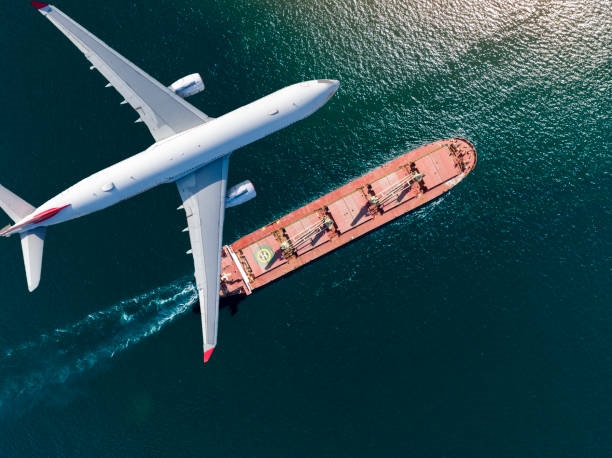
Cross-border sellers targeting the Latin American market are likely familiar with a calculation. This calculation often involves a recurring, agonizing question: should this shipment be shipped by sea or air?
Sea freight looks cheaper, saving tens of dollars per kilogram in initial shipping costs, but the goods drift across the Pacific for over a month, transiting through the US. By the time they arrive, the market hype may have died down, and competitors have already filled their positions. Air freight offers reliable delivery times, arriving in three to five days, but the profit margins are incredibly thin, resulting in minimal gains per order. This isn’t a joke; it’s the reality of logistics in Latin America. And combined sea and air transport strikes a perfect balance in between.
01 Sea-Air Intermodal Transport: Driving Down Costs and Recovering Time
This model is actually quite simple: bulk cargo is shipped from domestic ports to the United States by sea. After unpacking at the port, cargo connects to air freight within 2‑3 days. A local team then handles customs clearance and delivery. The sea leg saves cost. The air leg cuts delivery time to 35‑40 days. Early this year, China’s General Administration of Customs announced 25 trade facilitation measures. These explicitly promote multimodal transport. Projects in Pingtan, Dongguan, and other cities have grown fast. For example, the Dongguan‑Hong Kong airport center alone exceeded 65 billion yuan in three years. Multimodal transport is now a key trend in cross‑border logistics.
While the principles are clear, truly ensuring stable sea-air intermodal transport on Latin American routes requires more than just a specific model; it requires robust implementation capabilities for each route: Is the initial shipping schedule stable? Is the transshipment connection in the United States tight? Is customs clearance at the destination port smooth? Does the company have its own last-mile delivery capabilities? Any weakness in any link will break the 35-40 day delivery guarantee.
We have our own overseas warehouses and transportation fleets, covering warehouses, commercial addresses, and private addresses in these three locations. All shipments are fully cleared and tax-inclusive, with a one-stop service from customs clearance to tax payment and delivery upon arrival. We have regular weekly flights, stable and controllable warehouse space, and avoid temporary consolidation or order bundling. For sellers seeking worry-free door-to-door shipping, this fully controllable model is the biggest reassurance.
02 Who is this route suitable for? Find your niche
Sellers of medium to large-sized products, such as small appliances, kitchen appliances, home storage products, and hardware tools. For these product categories, air freight alone incurs staggering costs due to volume and weight, severely squeezing profit margins; while sea freight alone puts immense pressure on cash flow and excessively long replenishment cycles. Sea-air combined transport strikes a compromise between the costs of large shipments and relatively faster delivery times.
For sellers of jewelry and daily necessities, these products have numerous SKUs and large shipment volumes, making them highly sensitive to logistics costs while also demanding timely delivery—out of stock means missing the peak season window. The cost structure of sea-air combined transport allows for greater pricing flexibility in the Latin American market for these products. For specific categories like kitchen knives, knives are often subject to strict restrictions in air freight, with some airlines refusing them. Sea-air combined transport, with its initial sea leg, is more favorable for these products, resulting in a smoother overall process.
For replenishment-oriented sellers, this doesn’t refer to new product launches but rather listings with stable sales that require regular replenishment. These orders have clear expectations regarding delivery time and minimum cost requirements, making the rhythm of sea-air combined transport a perfect fit.
In short, if you fall into one of the following categories, you should seriously consider this option: Product categories—small appliances, kitchen appliances, kitchen knives, home storage, decorations, hardware tools, daily necessities; medium to large shipment volume per shipment; acceptable delivery time of 35-40 days, but not 50-60 days for pure sea freight; high cost sensitivity, requiring a significant price advantage over air freight. In this case, finding a reliable freight forwarder to help you plan the optimal route is far more efficient than trying different channels yourself.
03 Not an either/or choice, but an additional option
The value of air-sea combined transport is not to replace air freight or sea freight, but to provide an additional route in between. Use air freight for urgent shipments, sea freight for less urgent shipments, and air-sea combined transport for shipments in between. These three channels are available; choose according to your needs.
Besides air-sea combined transport to Latin America, we also have air and sea freight channels covering Latin America, the United States, Canada, and Europe. Different goods, different budgets, different deadlines—each has its corresponding shipping method. Cross-border logistics, at its core, is about accounting—cost accounting, time-sensitive accounting, and cash flow accounting. Sea-air combined transport brings one such algorithm to the forefront.
However, what truly makes this algorithm effective isn’t the model itself, but rather the experience and network of the implementers. A responsible freight forwarder will manage the connections at every stage, ensuring smooth customs clearance services and seamless door-to-door shipping. This is precisely what Z-LEADING has always focused on.
04 Your cross-border logistics partner: Z-LEADING, making choices simpler.
Founded in 2013, Z-LEADING boasts a self-operated warehousing network of over 30,000 square meters in Guangdong, Zhejiang, Beijing, the United States, and Europe, with a global team of over 500 people. We are a first-tier agent for DHL, UPS, and FedEx, capable not only of handling regular cargo but also of compliantly transporting dangerous goods such as lithium batteries and new energy products—areas many competitors cannot access.
On routes to Latin America, North America, and Europe, we integrate various modes of transport including sea freight, air freight, sea-air combined transport, and rail freight, with regular weekly flights, stable cargo space, and a one-stop service encompassing customs clearance and taxes. Whether you are a seller of small appliances, kitchen knives, or daily necessities, we can customize the most cost-effective and timely solution for you, making your customs clearance services smoother and your door-to-door shipping more worry-free. The choice of over 8,000 clients tells us: no gimmicks, just service—this is not just a slogan, but a commitment made consistent for over a decade.